
Who Owns Your Future Income? The Rise of RWA Human Capital Markets
Tokenization is moving beyond assets to ask whether human potential can become its own market.

Thestreet
April 27, 2026
·
4
read


A growing shift in the global economy is placing individuals, rather than companies alone, at the center of value creation. As new infrastructure develops, the idea of investing in people is moving from a theoretical concept into early-stage practice, creating both new opportunities and new uncertainties.
In 2026, this trend is becoming more visible across the market. Conversations are moving beyond companies and platforms toward individuals as standalone economic units around whom capital, attention, and revenue streams can be built.
This shift reflects pressure on traditional growth models. Access to capital is becoming more constrained in some areas, while conventional monetization channels are becoming less efficient. As a result, the market is searching for new sources of value and increasingly finding them at the level of individuals.
The drivers behind this transition are becoming clearer. The global digital advertising market continues to grow, but its efficiency is challenged by content saturation and intense competition for attention.
In this environment, attention alone is no longer enough. What matters more is the ability to retain an audience and convert that audience into sustainable revenue streams.
At the same time, the structure of work is changing. Companies are moving away from rigid organizational models and toward more flexible formats, increasingly hiring specialists for specific tasks instead of building fixed teams.
As a result, value is becoming less tied to organizations and more connected to individuals, their skills, and their ability to generate income independently. A growing share of economic activity is now being created outside traditional corporate structures, while capital is gradually moving toward individuals around whom their own economic ecosystems are formed.
From an investor’s perspective, the key question is whether individual income streams can be scaled.
The creator economy has already shown that individuals are capable of generating stable and repeatable cash flows. However, the current model remains largely operational. It depends on constant activity and does not provide equity participation, standardized valuation, or a structured way to treat future income as an asset.
This is where the concept of human capital markets begins to emerge. The shift is from monetization to capitalization: from simply earning income to structuring an individual’s future earnings as a measurable and potentially investable asset.
Emerging models point to the creation of infrastructure that can capture and distribute value generated by individuals.
In this logic, individuals begin to operate similarly to public companies, but without the need to create a formal corporate structure. Their audience, reputation, skills, revenue streams, and future earning potential can become the foundation of a new economic model.
This trend is connected to broader developments in Web3, ownership models, and digital identity. Leading venture firms are not only investing in sectors connected to ownership infrastructure, but are also supporting educational initiatives around these models. This signals strategic interest not only in technology, but also in the knowledge base required to support new forms of economic organization.
Projects are already emerging that combine social and financial functions into a single system. One example mentioned in the article is Sl8, a platform developed by Cassator Corp.
The core idea behind Sl8 is that individuals already generate a significant share of value in the digital economy, but rarely participate in its capitalization. Sl8 aims to change this by providing infrastructure where users can not only earn, but also build sustainable economic systems around themselves.
The platform brings together functions that are usually fragmented across different tools: audience engagement, financial transactions, monetization tools, and tokenized participation. These elements are aligned with emerging real-world asset models, where future income can be organized as a structured asset.
Applied to individuals, this means that a person’s earning potential — based on audience, expertise, influence, or trust — can be organized, tracked, and potentially invested in.
As a result, users can move beyond simply earning income and begin managing and scaling cash flows through their audience. Built on Stellar Distributed Ledger Technology, the system is designed to support relatively fast and cost-efficient transactions, which are important for these types of models.
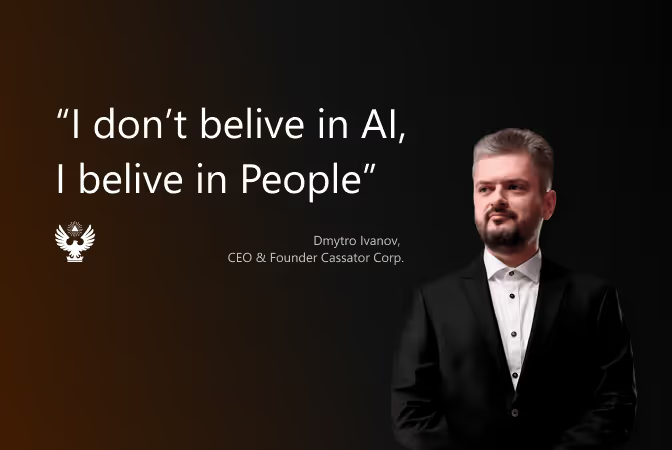
This approach reflects the view of Dmytro Ivanov, CEO and Founder of Cassator Corp., who puts it simply: “I don’t believe in AI. I believe in people.”
As AI continues to evolve, human qualities such as decision-making, meaning creation, and trust-building are becoming increasingly important sources of economic value. In this context, human capital markets are not about replacing people with technology, but about amplifying and capitalizing human potential.
The main challenge of human capital markets lies in valuation.
Unlike companies, individuals do not yet have clear or standardized metrics for assessment. The question is not only how much a person earns, but also how stable their audience is, how strong their reputation is, and how much trust they are able to build over time.
This suggests the emergence of a new valuation model combining influence, reputation, income potential, and audience stability.
At the same time, the market remains at an early stage and carries significant uncertainty. Risks include overvaluation, dependence on personal reputation, lack of unified standards, and unclear regulation. Existing legal and financial frameworks are not yet fully adapted to these models.
For this reason, trust infrastructure becomes essential. Transparency, KYC/AML practices, and control over financial flows will likely play an important role in shaping how human capital markets develop.
In a broader sense, the growing interest in human capital markets reflects more than a technological trend. It points to a deeper transformation of the economy, where human capabilities — the ability to make decisions, create meaning, build trust, and generate value — become a standalone source of economic potential.
A key question is how human capital market concepts may develop and how participants could begin to operate within them.
If previous stages of the economy were built around companies and platforms, the next stage may center on those who directly create value: individuals. This changes the focus of investment from structures to the capacity to generate, retain, and scale value.
For investors, this may represent a potential new area of interest. However, it also carries the typical challenges of an early-stage market: uncertainty, lack of standards, regulatory complexity, and the need to establish rules from the ground up.
The emerging question is how, and under what conditions, investing in individuals could be approached systematically — and who will be the first to do it at scale.



.avif)